Posts

Showing posts with the label VIOLENCE

A reflective review of conducting Criminological research.

‘Criminological research for beginners—A student’s guide’ is written by Laura Caulfield and Jane Hill who are both experts in criminological research and have conducted research themselves on a range of interests including criminal psychology, restorative justice and community approaches to crime and deviance. This book is in my opinion, an essential read for those such as myself who are new to the field of criminology and find use in reading about the learned experiences and empirical conclusions made from those who have conducted academic research as well as those who may wish to re cap on key skills and philosophical theories surrounding the methodologies and routines within criminological research. It can be argued that throughout reading the book, we are provided with a space to critically reflect upon our own epistemologies, ontologies, methods and attitudes to criminological research and how we can apply them to a real life, day to day framework when researching society, ind...
Zizek's voilence- Systematic voilence and it's commodification.

Zizek’s violence is a fresh and intriguing outlook onto the concept of violence. Violence is often perceived as being just physical, however Zizek proposes the compelling notion that the violence we see can be epistemologically understood by exploring political and economic systems. More namely, exploring consumer capitalism and Liberalism as systems which have generated systematic violence. The typologies of violence as being objective, subjective, systematic and symbolic are identified and throughout the book, you can begin to see where these terms of violence can be applied to the jigsaw puzzle that is society and individualism. Empirically speaking, Zizek explores current examples of where violence is displayed on a wider scale. Violent political outbreaks in Israel and Palestine are named examples, as well as drawing conclusions from global terrorism. Political philosophers such as Marx and Engels are also referred too throughout. I cannot help but agree with the notion...

Micro and Macro harms of Neoliberalism through the lens of violent and structural crime.

Day after day, the wider media issue reports on violent crimes, with a heavy focus on knife crime. It can be argued that the way in which violent crime is reported in the media focuses on pointing the blame on race, age, gender and the local communities in which they are immersed into. This blog aims to explore these narratives and to point out that the representation of violent crime, in the media is often misguided and does not truly reflect the reality as well as exploring central social structures and political philosophies which need to be held to account as well. On Monday April 1 st , 2019, BBC News published a headline on their website titled, - ‘Schools and NHS could be held accountable over Youth Crime’. https://www.bbc.co.uk/news/uk-477686 3 1 The article discussed the ways in which schools and the NHS have ‘failed’ to prevent youth groups falling into violent crime. First, this article is blatant evidence that the wider media are not willing to accept that the Pol...

A book review- Forensic Psychology, A very short Introduction by David Canter.

David Canter is Emeritus Professor of Applied social psychology at the university of Liverpool. He was also the creator of Investigative psychology. David Canter specialises in Environmental psychology, offender profiling and Forensic Psychology. After having read- Forensic psychology, a very short introduction, I was introduced to new concepts and a much clearer understanding of the role that forensic psychologists play in murder investigations. The book details, the court procedures in gaining a conviction for murder cases, additionally it also establishes the fundamental role of forensics, which arguably is to collect scientific evidence and to establish what is and isn’t there to either prove someone’s guilt or innocence in the context of the courtroom. Chapter two titled ‘how to make a criminal’   details physical and biological traits which have been used to construct a psychopath and murderer, this is for forensic psychologists to use as a stepping ladder to streng...

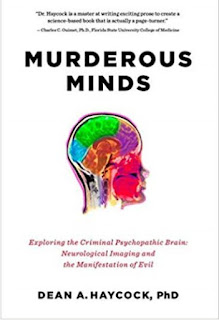
Muderous Minds- Dean A Haycock phD- A book review.

Image
Murderous Minds by Dean A Haycock- A book review.  Dean A Haycock is an author who I highly recommend for anyone studying Criminology, Psychology, anthropology, and Neuroscience. He specialises in Science and Medicine. This is shown through his PhD research in Neuroscience from the Brown University in Rhode Island. I thoroughly enjoyed reading his book ‘murderous minds’. It is important to note that the research displayed in the book does acknowledge the separation between psychopathy and violence.   This book does explore the minds of a subsection of psychopaths. They have been classified as ‘criminal psychopaths’. This is the distinction between those who have ‘successful psychopathic tendencies’ such as struggling to comprehend and adapt to social situations, reading body language and emotional cues, but do not act on these lacking abilities in a criminalising manner. Encompassing the ‘criminal psychopath’ Dean explains that there are characteristics which could m...

BOOK REVIEW: THE ANATOMY OF VIOLENCE

After having read the Anatomy of Violence by Adrian Raine, I first felt an immense sense of accomplishment. This Is because even though, I take a keen interest in Biology and the natural sciences, I do not study them full time, and I was able to understand the underpinnings of Raine’s arguments for the Biological roots of crime.   Adrian Raine was born in Darlington 1954, he is currently Professor of Criminology at the Richard Perry University Pennsylvania. His current research is based around Biological interventions for Anti-social behaviour, part of this research involves structural brain scanning to identify patterns in the brains of violent offenders. Raine also specialises in Neurocriminology and is in my opinion, the future of the movement of the discipline along with his previous PhD supervisor Peter Venables.   Throughout the book, Raine would talk about a leading argument and weigh it with substantial evidence. Much of this evidence I did agree would be a f...